
Can an Active Chair Help Reduce Back Discomfort From Sitting?
If your back starts aching around hour three of your workday, you’re not imagining it. Sitting still for long stretches puts real strain on your spine, even when you’re sitting “correctly.” The problem isn’t really about posture in the moment. It’s about staying locked in one position for way too long.
That’s the gap an active chair is designed to fill. Instead of holding you still, it keeps your body shifting in small ways throughout the day, which changes how your back feels by the time you log off.
Why Long Hours of Sitting Can Leave Your Back Feeling Stiff
Your muscles and joints aren’t built for stillness. When you sit in one spot for hours, blood flow slows down around the lower back and hips, and the muscles that should be supporting your spine start to relax instead of doing their job.
That’s when stiffness creeps in. It’s not usually one specific thing you did wrong. It’s more that your body wasn’t given a reason to move, so it didn’t.
A lot of everyday habits make this worse without you noticing. Sitting with your weight shifted to one side. Hunching toward the screen without realizing it. Staying in the exact same position through back-to-back meetings because standing up feels like a hassle. None of these are dramatic on their own, but they add up fast over an eight-hour day.
Posture also naturally changes as the day goes on, whether you want it to or not. You start upright and alert in the morning, and by mid-afternoon your body has quietly slid into a slouch. That shift happens because your muscles get tired of holding a “correct” position without any support from movement.
How an Active Chair Changes the Way You Sit
An active chair works differently because it doesn’t let you settle into one fixed spot. The base moves slightly as you shift your weight, which means your body is making small adjustments constantly instead of freezing in place.
That gentle movement is the whole point. Rather than sitting still and hoping your posture holds up, you’re subtly rocking, leaning, and readjusting the entire time. Your body stays a little more alert because it’s doing small amounts of work in the background.
It also tends to support a more balanced sitting position overall. You’re less likely to lean heavily to one side or slump into a backrest, because there isn’t a backrest pulling you into that shape in the first place.
One thing people don’t expect is how much more aware they become of their own posture once they switch. The best active sitting chair doesn’t fix your posture for you. It just makes it obvious when you’ve been sitting badly for a while, because your body naturally wants to correct itself.
Ways an Active Chair Can Support Everyday Comfort
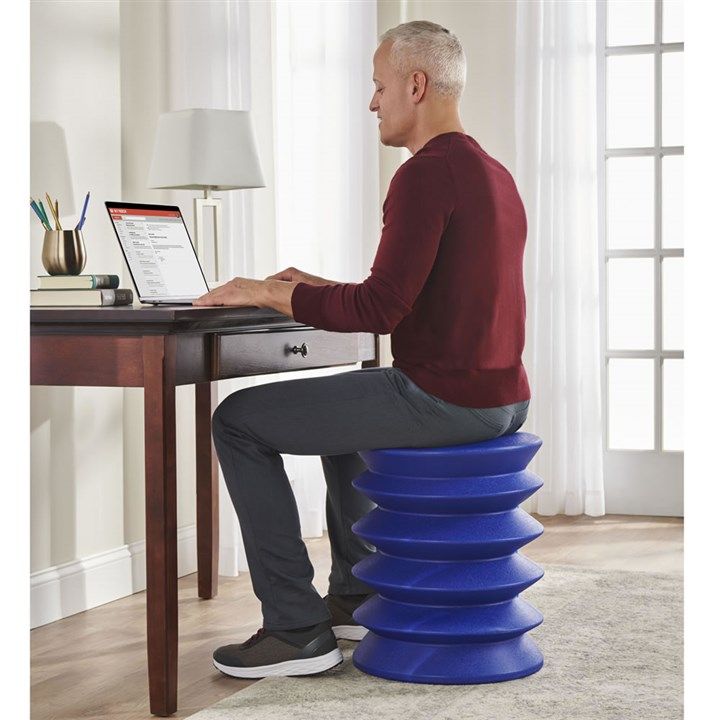
There are a few specific reasons people notice less back discomfort after switching to this kind of seating, and they come down to alignment, muscle engagement, and simple movement.
Encourages Better Spine Alignment
Active sitting promotes a posture that’s closer to how your spine naturally curves, instead of forcing it flat against a rigid backrest. Your lower back keeps more of its natural shape, which takes pressure off the discs that tend to flare up after long sitting sessions.
This also cuts down on prolonged slouching during desk work. Since you’re not resting against anything, your body has to keep making small corrections, and that habit of constant adjustment is what keeps you from sinking into a slouched position for hours at a time.
Engages Core Muscles While Sitting
Core muscles matter more for back comfort than most people give them credit for. A weak core means your spine gets less support from the inside, so it relies more on tensing up in ways that eventually cause discomfort.
Subtle, constant movement keeps those muscles switched on without turning your workday into a workout. It’s a low-effort kind of engagement, but it adds up, and it’s part of why people report feeling less tension in their lower back after a few weeks of regular use.
Helps Reduce Stiffness During Long Work Sessions
Keeping the body moving, even in tiny ways, prevents the kind of stiffness that builds when you’re frozen in place for hours. There’s a real, practical case for this the benefits of active sitting show up most clearly in people who used to feel locked up by the end of a long shift.
Better circulation is part of this too. Movement keeps blood flowing to areas that would otherwise stiffen up, which is a big reason people feel less achy in their hips and lower back after switching from a static chair.
Who Can Benefit Most from an Active Chair?
Office professionals who spend most of the day at a desk are an obvious fit, especially if their job doesn’t naturally involve much walking around during the day.
Remote workers with home office setups benefit for similar reasons, though often more so, since home setups are sometimes less ergonomic to begin with. A kitchen chair or dining stool wasn’t built for eight hours of sitting, and an active chair fills that gap without taking up much space.
Students during long study sessions deal with the same problem, just in a different setting. Sitting through hours of reading or coursework can leave anyone stiff, and active seating gives them a way to stay comfortable without constantly getting up.
Creative professionals who bounce between focused solo work and group collaboration also tend to like this style of seating, since it’s easy to move around a shared space without dragging a heavy chair along.
Making Active Seating Part of a Healthier Work Routine
An active chair works best as one part of a bigger routine, not a total fix on its own. Pairing it with regular standing breaks still matters, even if the chair reduces some of the discomfort from sitting still.
Setting up the rest of your workspace with good posture in mind helps too. Screen height, keyboard placement, and desk height all play a role, and an active chair works better when the rest of your setup isn’t working against it.
Choosing a chair that actually matches your height and workspace matters more than people expect. A stool that’s too tall or too short cancels out a lot of the benefit, so it’s worth taking the time to get that part right before assuming the chair itself isn’t working.
If you’re not sure which option fits your setup, it’s easier to ask than guess. Contact us and we can help you figure out what makes sense for your space and how you actually work.