
Active Sitting Stools for Core Strength: What We Tested and What’s Actually Worth Buying
Most office chairs that promise to build core strength don’t actually make your core do anything. You sit down, the chair holds you in place, and your muscles get to keep napping exactly like they were on your old chair. That’s the part nobody tells you when you’re scrolling through “best ergonomic chairs” lists at 11pm trying to fix a bad back.
We spent a few months testing different active sitting setups at our own desks, swapping between stools, balls, and a couple of kneeling chairs, trying to figure out what actually engages the core versus what just looks interesting in a product photo. The short answer: very few of them do what they claim. An active sitting chair that actually works needs constant, unforced movement in every direction, not a single tilt mechanism that snaps back to center the second you stop paying attention.
Why Most “Wobble Stools” Don’t Really Work Your Core
That distinction matters more than people think. A lot of “wobble stools” on the market use a weighted base that tilts and then pulls itself back upright. It feels like movement, but your core barely has to react because the stool is doing half the work for you. You get a little bit of motion, but not the kind that actually trains anything.
The stools that genuinely build strength move with you in any direction at once, no spring-back, no weighted base doing the balancing for you. Your body has to do the work of staying upright, which is the entire point. We found this kind of free, omnidirectional movement makes a real difference within the first couple of weeks of regular use. Posture improves a little faster, the afternoon slump hits later, and you actually notice when you’ve been sitting still too long because your body wants to shift.
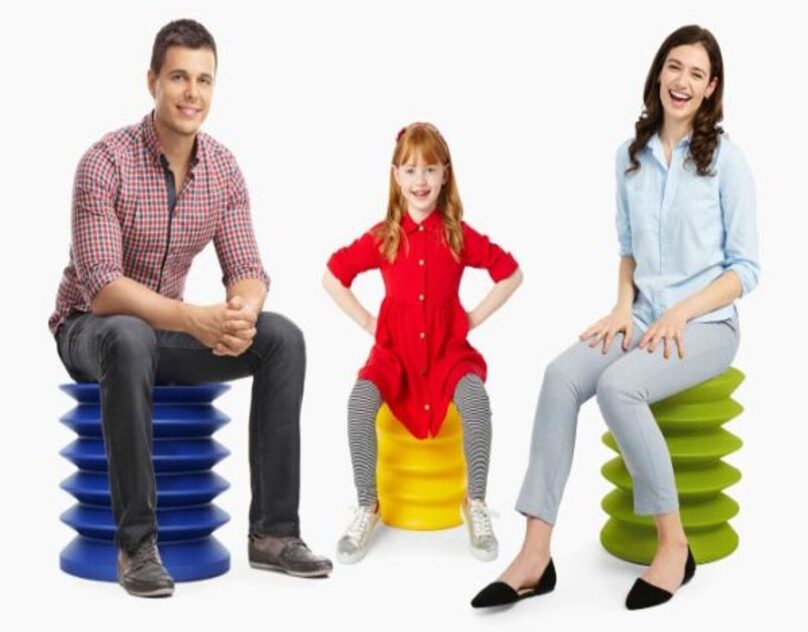
If you’re shopping around for healthy seating and you keep seeing the term “active sitting” thrown around, it helps to know that not all active sitting products are built the same way. Some rely on a mechanical tilt-and-return motion. Others use a flexible base, like an accordion or bellows-style structure, that compresses and moves freely without any springs or weighted parts to wear out over time. That second kind tends to hold up better and feels more natural after the first few sits, because you’re not fighting a mechanism, you’re just moving.
What We’d Actually Recommend (and What We Wouldn’t)
We tested a handful of products that get lumped into the “core strength chair” category, and honestly, a few of them don’t belong there at all.
Exercise balls are the classic example. They look great in theory. In practice, they roll away the second you stand up, they slowly deflate over a few months, and most desk setups aren’t built for a giant rubber ball anyway. We had one in an office a few years back and it ended up in a closet within a month.
Kneeling chairs are a different story but they have the same basic problem. They shift your weight from your sit bones to your shins and tilt your hips forward, which can genuinely help with posture if your issue is slouching. But your core isn’t doing extra work in that position. The load just moves somewhere else. If your goal is specifically core engagement, a kneeling chair isn’t the tool for that job, even though plenty of people recommend them for “active sitting.”
Then there’s the weighted wobble stool category, which is closer but still not quite there. These tilt up to a certain degree and the weighted base pulls them back to center. It’s better than a static chair, sure. But because the stool corrects itself, your core doesn’t have to do the full job of stabilizing you. You’re sharing the work with the mechanism instead of doing it yourself.
What Actually Held Up Over Time
What actually held up for us, both in terms of real core engagement and just being comfortable enough to use regularly, was a true accordion-style stool that compresses under your weight and lets you rock freely in any direction without any spring-back doing the work for you. No batteries, no weighted base, nothing mechanical to eventually fail. Just your own balance keeping you upright, which sounds simple but is exactly why it works.
It also matters that the stool actually fits your body. A 6’4″ person and a 5’2″ person engaging with the same seat height isn’t going to feel right for either of them, and that mismatch is part of why some people try active sitting once and give up. Picking a stool sized for your height range, with a weight capacity that actually matches you, makes a bigger difference than people expect.
For a setup that’s meant to live at a desk all day, an office active seat needs to compress down to roughly the height of a normal chair too, otherwise you’re stuck adjusting your whole desk just to use it. That’s a detail a lot of “active sitting” products skip, and it’s the reason some of them end up shoved in a corner after a week.
How to Actually Use One Without Wrecking Your Back
Here’s the part most reviews skip entirely: you can’t sit on one of these things for eight hours straight, at least not right away. Your stabilizing muscles have probably been dormant for years if you’ve been in a regular chair full time, and asking them to suddenly do a full workday of balancing is asking too much, too fast.
What works better is treating it like a tool you rotate in, not a full replacement for your regular chair. Start with short stretches, maybe twenty or thirty minutes during focused work, and build up from there over a couple of weeks. Use your normal chair for calls, long reading sessions, or anything where you need to sit still without thinking about it. The stool is for the stretches where you’re already moving around anyway, typing, thinking, shifting in your seat.
After a few weeks of that rhythm, most people stop thinking about it. You just naturally reach for the stool when you’re in focus mode and switch back when you’re not. That’s really the whole goal, getting your body back into the habit of moving instead of locking into one position for hours.
Where ErgoErgo Fits Into This
We’ve leaned into this approach with ErgoErgo, building stools around that bellows-style movement instead of a weighted tilt mechanism, specifically because it puts the work back on your core rather than splitting it with the base. It’s not going to fix a structural back problem and it’s not meant to replace your office chair entirely. But for the hours where you’re actively working and your body wants to move anyway, it does what most “core strength” seating only claims to do.
If you’re not sure which size or setup makes sense for your height, weight, or workspace, Contact us and we can walk you through it. It’s a smaller decision than people make it out to be, but getting the fit right is the difference between a stool you actually use and one that ends up as an expensive plant stand by week three.